 Summiva
Astronomy for toddlers: yes, even at 18 months
By Anand Yadav · @summiva.app · Posted 15 May 2026 · 8 min read

The first time my daughter Aanya pointed at the moon, she was about 13 months old. We were on our usual evening walk outside our home, and she stopped, lifted her arm, and stuck out one finger at the moon. She didn't say anything. She just looked.
That was the moment I knew we were going to do astronomy together.
My own fascination with the sky started years before Aanya was born. I remember watching a YouTube documentary called Journey to the Edge of the Universe and being unable to look away for the full hour and a half. The camera zoomed out from Earth past Saturn, past the outer planets, past the Oort Cloud, into the wider galaxy and then further. The fact that all of this was right there, every night, above us. I'd always wondered how the solar system formed, how stars are born, how the universe began. A YouTube video doesn't answer any of those questions. But it planted something. When Aanya was born in September 2024, I knew the sky was something I wanted to share with her early.
Starting outdoors before any tools
I started showing Aanya the sky when she was around 9 months old, in the summer of 2025. We were already in the habit of an evening walk outside our home, and one evening I just stopped under a clear patch of sky and said, "Look. Moon." I pointed. She followed the line of my arm with her eyes but mostly looked at me, not the moon.
This went on for weeks. Most evenings, when the weather and her mood agreed, we did the same thing. Sometimes I said "moon", sometimes "star", sometimes I just stood still and let her look. I didn't try to teach. I didn't have a target.
Around 13 months, in October 2025, she pointed for the first time. After that, the pointing became part of every evening walk. By 14-15 months, she'd say "moon" without prompting if she saw it.
This phase cost nothing. No book, no app, no projector. Just being outside, looking up, and naming the thing.
Adding the sky projector and 12 discs
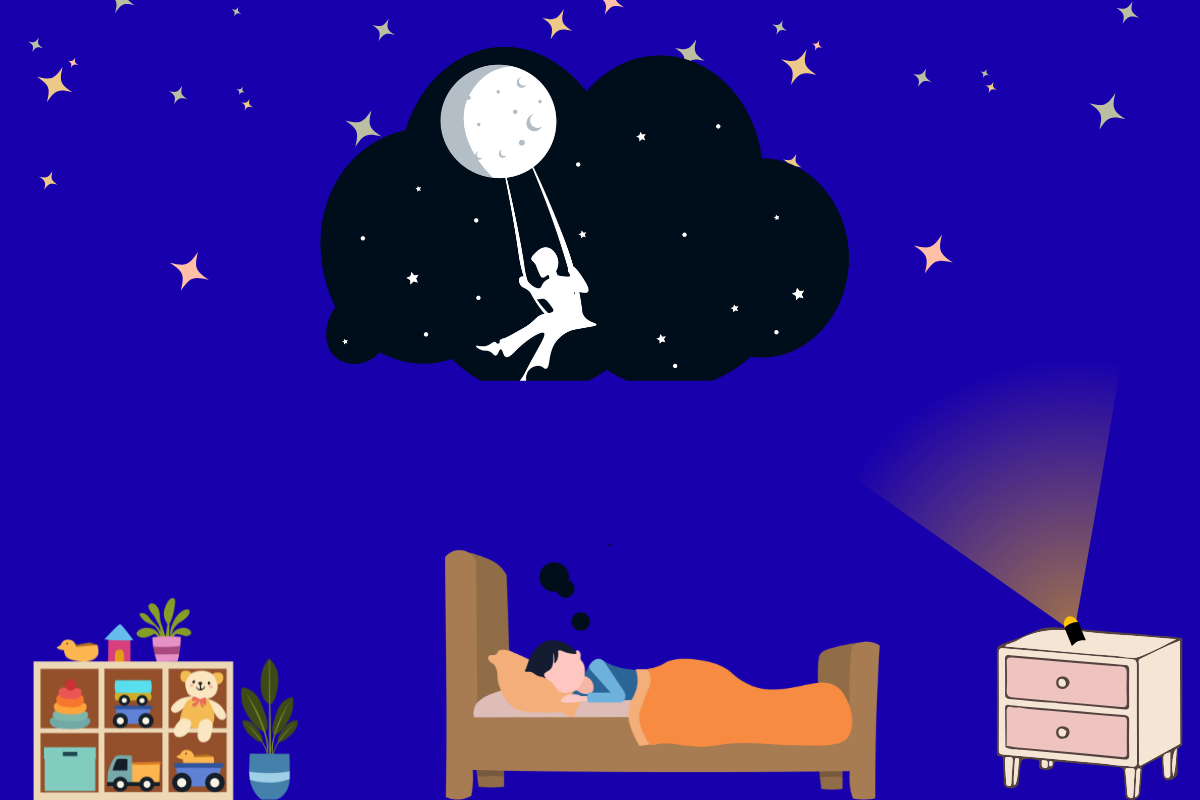
When Aanya was around 12 months, in September 2025, I bought a small home sky projector. It came with 12 discs: the moon, Earth and moon together, a nebula, the solar system, a galaxy, and several others I rotate through. Each disc projects an image onto the ceiling when you put it in the projector and turn off the lights.
I used the projector at bedtime, for about ten minutes, until she dozed off. The first disc I used was the moon. I waited until just before bed, switched off the room lights, slid the disc in, and pointed up.
Aanya stopped moving. She just looked. For maybe two full minutes she was silent, which at 12 months is significant. After that, "moon" became something she said indoors too. She started associating the indoor projected moon with the outdoor real one.
The projector didn't replace going outside. It became the second thing we did, after the walk. Outdoor first, then projector at bedtime. Same words, different surfaces.
We've been doing this for about eight months now.
What she does now, almost 2
Aanya is 20 months old as I write this, in May 2026. Here's where she is with astronomy at this age, in plain terms.
She points at the moon outside and says "moon" without needing prompting.
She points at stars in the real sky and says "star". She doesn't yet distinguish between stars and planes, which is fine.
When I project the Earth disc, she lights up and says "ball". Then she touches the blue parts of the projected image and says "water". She's noticed that Earth is mostly blue. I have not taught her this. She got there herself.
She watches the nebula and galaxy discs but doesn't have a word for what she sees. When I project them, I say "this is a nebula. It's where stars are born." She listens, then loses interest after about thirty seconds. That's fine too.
She has not memorised any planet names. She can't tell Mars from Earth in the projector. None of that is the goal at 20 months.
Why the outdoor sky still does more than the projector
I bought the projector hoping it would be the main thing. It isn't.
The outdoor sky still does more emotional work than any disc. When Aanya points at the real moon outside, she pauses. There's a stillness in her body that doesn't happen with the projector. The real sky is colder, vaster, and farther away. Something in her registers that, even at 20 months, in a way she doesn't register an image projected onto a bedroom ceiling.
The projector is useful. It fills in the gaps when the sky is cloudy, when it's raining, when bedtime falls before sunset. It also extends the range. There is no way I'd show her a nebula or a galaxy without it.
But if I had to give up one of them, I'd keep the outdoor walks and lose the projector. The reverse would lose more.
If you're a parent thinking of starting astronomy with a young toddler, start outside. Tools come later.
Is 18 months too young for astronomy?
The honest answer: no. We started at 9 months and it worked.
But the form matters. Eighteen months is too young for facts. Aanya does not need to know that Saturn has rings or that the Milky Way is a galaxy. Trying to teach those things at this age would be a waste of time and would probably create resistance.
Eighteen months is exactly right for wonder. Toddlers respond to scale, brightness, and the strangeness of looking up. They have no defence against awe yet. Once kids learn that adults consider some things "boring", awe gets harder. Eighteen months is before that filter.
What works at this age:
- Repetition of the same simple words like moon, star, sun
- Watching, not quizzing
- Letting them point first, naming second
- Short sessions, 5-15 minutes
- No quizzes, no flashcards, no "what's that?" tests
What doesn't:
- Books with paragraphs of text
- Anything timed
- Anything that asks them to recall a name
- Apps that are clearly designed for older kids
A 3-step toddler astronomy routine
This is what we actually do each evening, written out. It's nothing fancy.
- Outdoor sky pointing, 5-10 minutes after sunset. Step outside our home, hold her, look up. Point at the moon if it's visible. Point at the first stars. Say the words. Wait. If she points, great. If she doesn't, also fine. We do this most evenings during our walk.
- Indoor projector, ten minutes at bedtime until she dozes off. Switch off the room lights, slide in one disc, turn it on. Most nights I pick the moon or a nebula. Some nights she's asleep before the disc finishes its slow rotation.
- Same words, every time. Moon, star, sun, Earth, ball, water, nebula. I don't add new vocabulary every week. I let her get familiar with the small set first.
That's it. No app, no curriculum, no goal.
I've gone deeper into each of these activities in a separate post on toddler astronomy activities, including the exact words I use and what I deliberately do NOT do. For the whole journey from age 1 to 12, see astronomy for kids at home.
What I'm planning for ages 2 and 3
Aanya turns 2 in September 2026. By then, I'll add picture books of the solar system. By 3, I'll start naming the planets in order, the way other parents teach colours or shapes. By 4, simple constellations on clear nights. By 5, maybe a small telescope and pointing at Saturn or Jupiter when they're visible.
I built Summiva partly to give myself a structure for this. The app's astronomy track has a "sky familiarity" stage that maps to roughly where Aanya is now, and progresses through "solar system" and "constellations" over years. I don't follow it strictly. But it removed the question "what's the next thing?" from my own head, which freed up the actual evening walks.
If I had a young toddler and was starting from scratch today, I would not buy the projector first. I would just start walking outside in the evening.
FAQ
Is 18 months too young to learn about space?
No. Eighteen months is a great age for wonder-based exposure. In our case we started even earlier, at 9 months. It's too young for facts or memorisation, but ideal for the kind of looking and pointing that lays the foundation for later learning.
What's the best astronomy resource for toddlers?
The outdoor sky after sunset, for free. A small home sky projector with a moon disc is a useful indoor supplement. Skip apps and books with text at this age.
When can kids learn the names of the planets?
Around age 3-4, in my experience. Earlier, the names don't stick because there's no context. By 3, kids start to enjoy the rhythm of "Mercury, Venus, Earth, Mars" the way they enjoy nursery rhymes.
How often should I do astronomy with a toddler?
A few minutes most days beats a long session once a week. Astronomy at this age is about repeated exposure to the same simple words, not depth.
How long should each session be?
Five to ten minutes outdoors, ten minutes max indoors with a projector. Toddlers' attention spans are short. Stop before they get bored.
I built Summiva for parents like me: people with long-horizon goals for their kids and no idea what to do this week. See the app or read why I started it.
Turn this into one calm week
Summiva turns goals like this one into a few small real moments a week, matched to your child's age. Built by the parent who wrote this post. Free to start, no card.
One goal free forever. No streaks, no guilt.