 Summiva
Toddler astronomy: 4 simple activities you can do tonight
By Anand Yadav · @summiva.app · Posted 18 May 2026 · 9 min read

Most parenting content recommends doing 9 activities or 15 activities or "47 things to enrich your toddler this week". I tried 4 activities for astronomy with my daughter Aanya. They worked. I don't think more is needed at this age.
Aanya is 20 months old. We've been doing toddler astronomy since she was about 9 months. The full list of what we actually do takes maybe 15 minutes a day, costs nothing extra most evenings, and uses one small piece of equipment that I'll mention but isn't required to start.
If you're looking for an honest, doable list of toddler astronomy activities, here it is. I covered the philosophy of starting astronomy young in an earlier post. This one is just the playbook.
Activity 1: Outdoor sky pointing
The most useful astronomy activity I do with Aanya costs nothing. It's stepping outside after sunset and pointing at the sky.
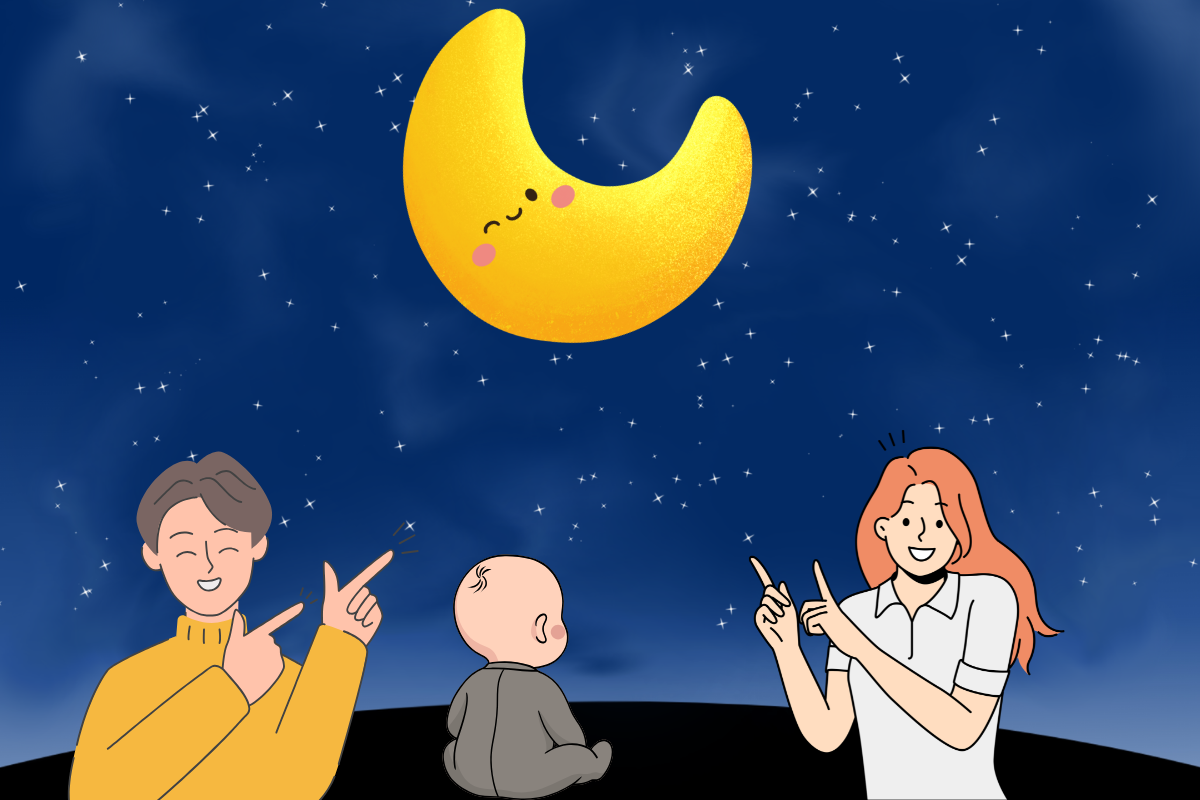
We started this when she was around 9 months old. I'd carry her on our evening walk outside our home, stop under a clear patch of sky, point at the moon, and say "Look. Moon." For the first few weeks, she mostly looked at me, not the moon. Around 13 months, she pointed at the moon herself for the first time. By 14-15 months, she'd say "moon" without me prompting if she saw it.
Here's what I do:
- Pick the moon first. It's the easiest target. Visible most clear nights. Bright. Recognisable.
- Point with my whole arm, slowly, while saying the word.
- Wait. Let her look. If she doesn't look up, fine. Don't force it.
- Add stars only after she's comfortable with the moon. Usually after a month or so.
What I do NOT do:
- Ask "where's the moon?" or test her on what she sees.
- Try to explain anything (phases, gravity, anything).
- Insist on her saying the word back.
- Pull out a phone or app to look something up.
The activity is the most boring thing on the list. It's also the one that works best. The outdoor sky does emotional work no screen or projector can replicate, even with a 9-month-old who can't articulate any of it.
If you do nothing else from this post, do this one. Free. Five minutes. Most nights.
Activity 2: Sky projector at bedtime
When Aanya was around 12 months, in September 2025, I bought a small home sky projector. It came with 12 discs: moon, Earth and moon, nebula, solar system, galaxy, and several others. The projector throws an image onto the bedroom ceiling when the lights are off.
I use it at bedtime, 10 minutes before sleep, until she dozes off. The routine is:
- Get her ready for bed.
- Switch off all room lights.
- Pick one disc. Slide it in. Turn the projector on.
- Lie down next to her. Look up. Say the word for what's projected.
- She watches until she falls asleep, usually within 10 minutes.
Which discs work at 18-20 months:
- Moon is the all-time best. She recognises it immediately. Same word she uses outside.
- Earth (with moon) triggers "ball" and "water". She got there on her own; I never taught her Earth was blue or had water.
- Sun is recognisable but less interesting to her.
- Nebula and galaxy are abstract. She watches but doesn't have a word for it. I narrate ("nebula, where stars are born") and accept she doesn't engage.
- Solar system is too busy. Too many objects.
The projector is useful but optional. It fills in when the sky is cloudy or when bedtime is before sunset. If I had to give up either the outdoor pointing or the projector, I'd keep the outdoors. The projector is the second priority, not the first.
Activity 3: The "ball and water" moment
This isn't an activity I do. It's an observation about how toddler astronomy actually works.
One evening, I projected the Earth disc onto Aanya's ceiling. She lit up. She said "ball". Then she pointed at the blue parts of the projected image and said "water". I had not taught her either. She put it together herself.
That moment changed how I think about teaching anything at this age. The "activity" in toddler astronomy isn't really an activity. It's exposure. You show her things. She notices what she's ready to notice. Repeat.
What this means for parents:
- Don't pre-write the lesson plan. You can't predict what your toddler will lock onto.
- Don't quiz them on what you projected. They'll surface their own observation when they're ready, and it'll be more interesting than your quiz.
- Don't worry that you're "not teaching enough". Their brains do most of the work.
- Repeat the same disc several times. Aanya didn't get "ball and water" the first time the Earth disc was projected. It came around the fifth or sixth time.
The implication: a small number of activities, repeated many times, beats a long list done once each. Aanya has seen the moon disc maybe 60-80 times by now. She'll see it another 200 times before she ages out of it. Every viewing reinforces the connection.
Activity 3 isn't an action. It's a mindset: assume your toddler is doing the connecting in the background. Your job is to provide raw material, not lectures.
Activity 4: Narration without quizzing
The fourth activity is how I talk to her about astronomy. I narrate. I don't quiz.
The full vocabulary list of words I use for astronomy is small:
- moon
- star
- sun
- Earth
- ball (Aanya's word for any spherical object including Earth)
- water (her word for the blue parts of Earth)
- nebula
- night
- dark
That's it. Nine words across all our astronomy time. I have not added new vocabulary since around 16 months. I keep using the same words.
What I say:
- "Look. Moon." Pointing at the moon.
- "Star." When she notices a star.
- "Nebula. It's where stars are born." When the nebula disc is on.
- "Same one as outside." Sometimes, when I want to link the projected moon to the real moon.
What I do not say:
- "Can you say moon?"
- "What's that?"
- "Where's the moon? Show me."
- "Saturn has rings. Did you know that?"
- "How many stars can you count?"
The "no quizzing" rule is the single thing I'd want every parent to take from this post. Toddlers process language they hear. They don't need to be tested on it. Testing creates resistance and replaces wonder with performance pressure.
The narration is repetitive on purpose. Aanya hears "moon" maybe 50 times a week. Every reinforcement makes the word stick. She didn't learn "moon" by being asked. She learned it by hearing me say it the same way, with the same target, for months.
What I'm NOT doing (and why)
These are toddler astronomy activities I've seen recommended in other parenting content. I skip all of them.
- Flashcards of the planets. Aanya is 20 months. She doesn't need to know Mercury through Neptune. Flashcards turn discovery into a memory test.
- Pre-made astronomy curricula for toddlers. Most are written for ages 3-5. Forcing them on a 20-month-old creates failure for both of us.
- Telescopes at this age. Telescopes need patience, instruction, and visual sophistication that toddlers do not have. Save this for age 5+.
- Apps that quiz on planet names. Same problem as flashcards, with a screen.
- Books with paragraphs of text. She has zero interest in being read facts. Picture books with one word per page are coming later.
- YouTube astronomy videos for kids. They're designed for ages 4-7 and overwhelm a toddler with sound and pace.
I'm not against any of these for older kids. I'm against them at 20 months because they don't fit how a toddler actually engages with the world.
When to add more activities
The 4 activities above cover Aanya from age 9 months through 2 years.
What I'll add at age 2 (September 2026):
- A few picture books of the solar system, one image per page, no text-heavy explanation
- A printed picture chart of the Earth, sun, and moon for the fridge
What I'll add at age 3:
- Naming the planets in order, casually, like nursery rhymes
- Possibly a NASA Space Place video, very short
What I won't add until age 5:
- Telescope
- Constellation identification
- Anything timed or quizzed
The pattern: add ONE new thing per year. Repeat the existing activities daily. Don't replace what's working.
FAQ
What's the best activity for teaching toddlers about space?
Outdoor sky pointing at the moon. It's free, takes 5 minutes, works on toddlers as young as 9 months. Everything else is supplemental.
Is screen time okay for astronomy at this age?
A sky projector is not the same as screen time. It's a passive ambient light that's gone in 10 minutes. Active screen time (phones, tablets, videos) at 18-20 months has no benefit for astronomy, and major health bodies recommend avoiding screen media for children under 2.
Do I need to buy any equipment for toddler astronomy?
No. The outdoor sky is free. If you want one supplement, a home sky projector with a moon disc is the single best cheap buy. Skip telescopes, books, apps, and curricula at this age.
When should I add more astronomy activities?
Don't rush. The 4 activities above cover ages 1-2. Add picture books at age 2. Add planet-name games at age 3. Add a small telescope at age 5. The biggest mistake parents make is over-loading their toddler with structured "enrichment".
If you're starting toddler astronomy from scratch, also read why I started at 18 months, and for the full age-by-age guide, see astronomy for kids at home. I built Summiva to help parents plan long-term goals for their kids. See the app.
Turn this into one calm week
Summiva turns goals like this one into a few small real moments a week, matched to your child's age. Built by the parent who wrote this post. Free to start, no card.
One goal free forever. No streaks, no guilt.