 Summiva
How to teach a toddler to read (the honest answer)
By Anand Yadav · @summiva.app · Posted 29 June 2026 · 8 min read
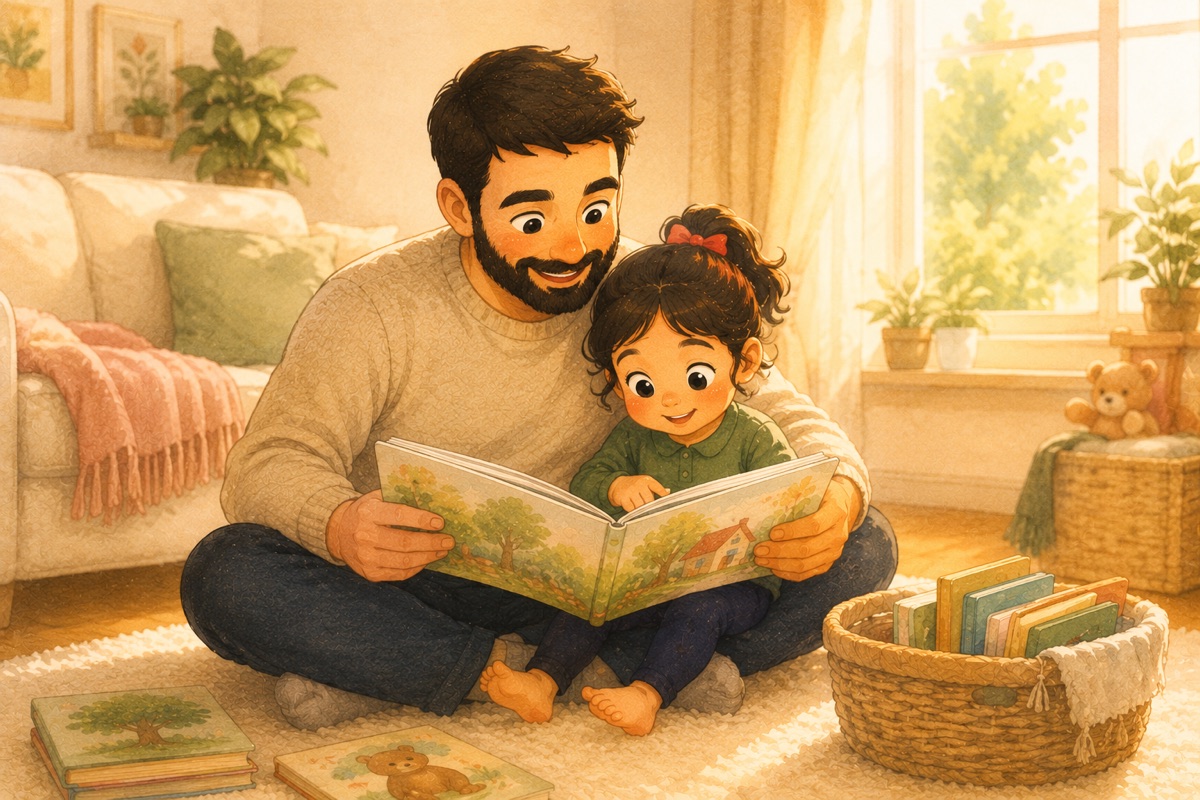
If you have typed "how to teach a toddler to read" into Google late at night, you have already met the adverts: programmes, flashcard packs, apps that promise your two-year-old will be reading by Christmas. Here is the honest answer, the one nobody selling a course will give you. You cannot really teach a two-year-old to read, and pushing too hard can quietly backfire. What you can do, starting today, is build the foundation that every reader stands on. That part is real, it is mostly free, and your toddler will barely notice it is happening.
The honest answer, and why it is good news
Can you teach a toddler to read? Not in the sense most people mean, decoding words on a page. Most children learn to do that between the ages of six and seven, and there is no good evidence that forcing it at two buys any lasting advantage. What the toddler years are genuinely for is the spoken language, the listening, and the love of books that real reading later grows out of.
My daughter Aanya is twenty-two months old. She will go to the shelf, pick a book she loves, climb up, and "read" it to me. Her speech is not fluent yet, so it comes in a few words at a time: half a line here, a name she recognises there, the rhythm of the story more than the exact words of it. She is retelling what her mother and I have read to her, over and over. The first time she did it I felt that little jolt of pride: my kid is reading. She is not, not yet. She is giving back a story she has heard a hundred times, from memory and from the pictures. And that is not a lesser thing. It is exactly the foundation working.
Open Instagram and it can feel like every other parent is running flashcards with their toddler: the alphabet, sight words, the whole drill. I am not going to tell you that is wrong, plenty of loving parents do it. But it is the one thing I looked at and felt, quietly, that I did not want to do with Aanya. So we didn't. The flashcards never came into the house. We kept the books out instead, and let her come to letters in her own time. I have since written the full case, sixty years of evidence and sales history, in why we skip flashcards.
Wait, didn't those "your baby can read" programmes work?
This is worth slowing down on, because the marketing is everywhere and it is persuasive. The most famous product in this category, "Your Baby Can Read", sold millions of units before the company shut down in 2012 following a US Federal Trade Commission complaint over its claims. The science had already caught up with it.
In 2014, researchers led by Susan Neuman at New York University ran a proper randomised trial of a baby-reading media product with infants aged nine to eighteen months. Over seven months, some families used the product and some did not. The result was blunt: the babies did not learn to read. There was no measurable effect on reading ability, even though many parents were convinced it was working. What the parents were seeing was their child memorising and recognising whole word-shapes, which looks like reading and is not.
That distinction is the whole game. Recognising the shape of the word "cat" on a flashcard is memorising a picture. Reading is knowing that the letters c, a and t carry the sounds that blend into the word, so you can also read "cot", "cap" and a thousand words you have never been shown. Toddlers are brilliant at the first thing and not yet wired for the second. No product changes that.
What reading is actually built from
It helps to see what you are really aiming at. The clearest model of how reading works is Hollis Scarborough's Reading Rope. It describes reading as two big strands twisted together. One strand is word recognition: phonological awareness, decoding, recognising familiar words on sight. The other is language comprehension: vocabulary, background knowledge, understanding how sentences and stories are built.
A skilled reader needs both strands woven tight. Here is the part that matters for you tonight: the decoding strand is a school-age job, but the language-comprehension strand is built almost entirely in the years before school, through talking and being read to. When you chat with your toddler and share books, you are not killing time until "real" learning starts. You are laying down half of the rope, the half that most struggling older readers turn out to be missing.
The five roots of reading
So what do you actually do with a one or two-year-old? I think of it as five roots, drawn from the early-literacy practices that public libraries and programmes like Reach Out and Read have built on for years. None of them look like school. All of them grow readers.
- Talk. The single biggest one. Narrate your day, name what you see, ask questions and leave gaps for them to fill. The more words a child hears in real conversation, the larger their vocabulary, and vocabulary is the engine of comprehension later.
- Read. Share books every day, even for five minutes, even the same book for the fortieth time. Let them turn the pages and point. You are teaching that books are warm, interesting and theirs.
- Sing. Nursery rhymes and songs are sneaky phonics. Rhyme and rhythm train the ear to hear that words are made of smaller sounds, which is the seed of decoding later.
- Play. Pretend, build, scribble with chunky crayons. Mark-making is the first step towards writing, and imaginative play builds the story sense that comprehension rides on.
- Notice print. Point out the letter their name starts with on a sign, the words on a cereal box, the logo on the bus. This is "print awareness", the gentle realisation that those marks everywhere mean something.
Notice what is not on the list: drilling letters, sounding out words, worksheets, screens that promise reading. None of those are the toddler job. The five roots are.
What it looks like in a real week (with my 22-month-old)
None of this is a curriculum. It is a handful of small moments folded into days that are already busy, and in our house they get shared out without anyone planning it. Her mother reads to her in English. I read the same kinds of stories in Marathi, sometimes Kannada. And her grandmother, my mother, sings to her in Kannada and Marathi. Three of us, more than one language each, the same few board books on heavy rotation, and Aanya turning the pages for all of us.
That is the whole thing. If you have ever worried that you are "not doing enough" for your toddler's reading, look at that list again. You are almost certainly already doing most of it. The trick is not adding pressure, it is noticing these moments count and protecting a few of them on the busy days.
That gentle, one-small-thing-a-day rhythm is the entire idea behind Summiva. It hands you a simple weekly plan of tiny, real moments towards a goal you have chosen, reading included, so you are never staring at a blank evening wondering what you are supposed to be doing. No flashcards. No guilt.
So when should a child actually learn to read?
Most children learn to decode between ages six and seven, often in their first year or two of formal school. Some click earlier at four or five, some later, and by around age twelve the early starters and late starters have largely evened out. A wide range is normal, not a problem to fix.
The economist Emily Oster, who reviews the parenting evidence carefully, makes the useful point that the year to watch most closely is first grade, around age six, when decoding should start to click. If it genuinely is not by then, that is the time to ask questions and get support, earlier rather than later. Before that, the most valuable thing you can do is keep the foundation growing and keep books a pleasure. Signs your toddler is on track are simple: they enjoy book time, they are talking and adding words, they join in on rhymes. That is it. And if you want the whole journey in one place, birth to ten, stage by stage, I have mapped it in reading milestones by age.
If your toddler wants more, follow their lead
Some toddlers do reach for letters on their own. They point and ask "what's that?", they spot the first letter of their name everywhere, they want the alphabet song nine times. If that is your child, lovely, follow it. Following is very different from pushing.
When they ask, give them the sound a letter makes more than its name, because "mmm" helps with reading in a way that "em" does not. Keep it in the flow of play and books, not a sit-down lesson. And watch their face. The moment interest tips into restlessness, stop, with no disappointment shown. You want them to leave every encounter with letters wanting a little more, never relieved it is over. A child who stays curious will outrun a child who was drilled, every time.
If the letter-sounds question has you wondering whether it is time for actual phonics, I go through the whole timing question, and what to do instead in the meantime, in when to start phonics for toddlers.
What to skip before four or five
Knowing what to leave alone protects the foundation as much as anything you add:
- Flashcard drills. They teach word-shape memorising, not reading, and they make the whole thing feel like a test.
- Worksheets and "tracing" books for toddlers. Their hands and attention are not ready, and the point at this age was never the page.
- Apps that promise to teach reading. The evidence is not on their side, and a screen cannot give a toddler the back-and-forth a real person does.
- Comparing your child to anyone else's. The neighbour's three-year-old "reading" is almost always reciting from memory. Yours is fine.
- Treating quiet absorption as failure. Most of the work at this age is invisible. Keep going through the stretch where nothing seems to be happening.
If you do the five roots and skip this list, you are giving your child more than any expensive programme can. You are raising someone who arrives at real reading already in love with books, and that love is the thing that carries them through the hard part of actually decoding. The reading will come on its own clock. Your job is just to keep the soil rich and the books out. One calm week at a time.
Frequently asked questions
Is my 2-year-old too young to read?
For decoding actual words, yes. Most children learn to decode between ages six and seven, and there is no proven long-term advantage to forcing it earlier. But two is the ideal age for pre-reading: talking, shared book time, songs, rhymes, and noticing print. That foundation is what real reading later grows from.
Should I teach letter names or letter sounds first?
If you do anything with letters, sounds matter more for reading than names, because reading is built on connecting sounds to letters. But at two, neither one is the priority. Far more useful is plenty of talk, rhymes, and shared books. Let letters come up naturally in play, not as a drill.
Are reading apps good for toddlers?
Apps and videos that promise to teach a baby to read do not deliver. A randomised trial of one popular baby-reading product found no effect on reading ability. Live talk and reading aloud with a real person teach far more than a screen at this age, and pediatric guidance favours limiting screens for under-twos.
My toddler memorises books, is that reading?
Not technically, and that is completely fine. Reciting a memorised book from the pictures is not decoding the words, but it is a genuine pre-reading milestone. It shows your child loves books, understands how stories work, and knows print carries meaning. Celebrate it. It is the foundation doing exactly its job.
We speak more than one language at home, will that delay reading?
No. Growing up with more than one language does not cause reading delay. Multilingual children may briefly mix words, which is normal, and they sort it out. Reading aloud and talking in any of your home languages builds the same foundation. For more on this, see will learning Spanish confuse my toddler?.
Turn this into one calm week
Summiva turns goals like this one into a few small real moments a week, matched to your child's age. Built by the parent who wrote this post. Free to start, no card.
One goal free forever. No streaks, no guilt.