 Summiva
Pre-reading activities for toddlers (no flashcards)
By Anand Yadav · @summiva.app · Posted 1 July 2026 · 7 min read
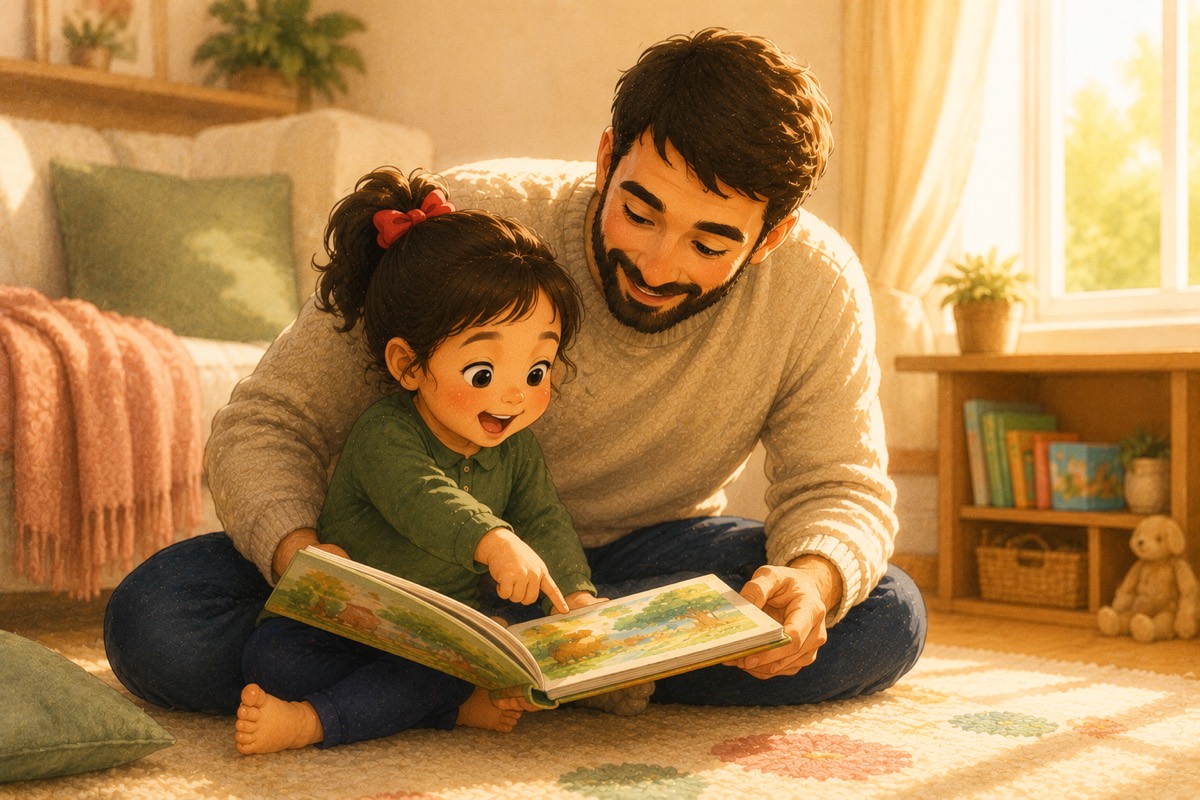
If you have already decided against drilling your toddler with flashcards, and you have read that real reading comes later anyway, you are left with a fair question. Then what am I actually supposed to do? This is the answer to that one. Not a curriculum, not a programme, just the small, ordinary activities that build a reader long before any child decodes a word. We do them with our daughter Aanya, who is not yet two. Most cost nothing, most take five minutes, and none of them look like school.
What is a pre-reading activity?
A pre-reading activity is anything that grows the spoken language, sound awareness, and love of books that reading later stands on, without trying to teach a child to decode words. It is the doing side of what I have called the five roots of reading: talk, read, sing, play, and notice print. That post explains why this stage matters and why forcing letters early tends to backfire. This one is the practical half. Here is what each root looks like on a normal, slightly chaotic day.
Talk: turn the day into a running commentary
The most powerful pre-reading activity needs no equipment at all. It is talking, in ordinary quantity, directed at your child. Vocabulary and oral language are the strongest early predictors of how reading goes later, which is why the guidance for one and two-year-olds keeps coming back to conversation over drills.
So narrate. Say what you are doing as you do it, name what you both see, and describe things in a few more words than feel strictly necessary. Not "here", but "here is your blue cup, it is full of cold water". Then leave gaps. Ask a real question and wait, even when you know they cannot fully answer yet, because the pause is an invitation.
The trick I like best is to echo and extend. When Aanya points and says "water", I do not just agree. I hand it back a little bigger: "yes, water, cold water in your cup". She keeps the one word she has and hears the three around it. Do that a few dozen times a day and you are not teaching a lesson, you are pouring in the raw material that comprehension later runs on.
Read: the same book, made into a conversation
Reading aloud is the centre of all of this, and you get far more out of it by making it two-way rather than a performance. Researchers call the two-way version dialogic reading, and the practice is simple: you read less and you ask and listen more.
In practice that means letting them hold the book and turn the pages, even out of order. Point at things and ask "what is that?" or "where is the dog?". Pause on the last word of a rhyming line and let them fill it in. And when they want the same book for the fortieth night running, give them the same book. Repetition is not boredom to a toddler, it is how they take ownership of a story.
Aanya does this to me without being asked. She will pull a book off the shelf, hand it over, and then the moment we settle in she takes charge. Sometimes she flips three or four pages ahead of where I am reading, chasing a picture she already has in mind. More often she takes the book out of my hands altogether, turns the pages herself, and points at every object on each one, asking me what is this, what is this, what is this, until we have named the whole page. We almost never get through a book front to back any more. I have made my peace with that, because her version, the flipping and the pointing and the naming, is the activity. I am just there to supply the words.
Here is where that leads. Aanya will now go to the shelf, pick a book she loves, and "read" it back to me. Her speech is not fluent, so it arrives in fragments: half a line, a name she recognises, the shape of the story more than its exact words. She is not decoding anything. She is retelling something she has heard a hundred times, from the pictures and from memory. It looks like a party trick and it is actually the whole point, a child who knows that books hold stories and that stories are hers to tell.
Sing: rhymes, and clap the sounds
Songs are sneaky phonics. Rhyme and rhythm train the ear to notice that words are built from smaller sounds, and that awareness is the seed that decoding grows from years later. You do not need to be able to sing. You just need to be willing to, badly, often.
So sing the nursery rhymes on a loop, and add two small games to them. First, clap the beats of words: break a word into its parts and clap each one, including their own name. Aanya claps out as two, "Aa" and "nya", and finds it hilarious. Second, make up little tuneless songs about whatever is happening, the putting-on-socks song, the walking-to-the-park song. Silliness is doing real work here.
You do not always see it going in, and then one day it surfaces. Aanya has started reciting Twinkle Twinkle back to us, not in the right order and not in neat lines, a proper toddler's version with words in the wrong places and whole bits missing. What surprised me is that she does it unprompted, breaking into it out loud in the middle of doing something else entirely. That is the rhyme having taken hold, the sound and the pattern first, the exact words and order much later. It is precisely what you are hoping to see at this age.
In our house the singing is not even mostly mine. Aanya's grandmother, my mother, sings to her in Kannada and Marathi, the same rhymes she sang to me. The language does not matter for this. The ear learns that sound has pattern whether the words are English or Kannada, and that learning carries across all of them.
This ear-building is the whole reason real phonics can wait. I go through what phonics actually is, why it is not a toddler skill, and when it genuinely does start, in when to start phonics for toddlers.
Play: act it out, and make marks
Play is where two different reading muscles get built at once: the sense of how a story goes, and the hand that will one day write. Neither looks academic, which is exactly why it works.
Act favourite books out with whatever toys are lying around, or with your hands as puppets, so the story lifts off the page and becomes something you both do. Give them playdough and roll snakes and circles together, the raw shapes letters are made of, without once calling them letters. Spread a thin layer of flour or fine salt on a tray and let a finger draw lines and loops in it. Hand over chunky crayons and let them scribble with no expectation of a picture. That scribbling is mark-making, and mark-making is the first rung of writing. What you are skipping here matters too: no tracing worksheets, no "hold the pencil like this". Their hands are not ready, and the point was never the neat page.
Notice print: letters in the wild, not on cards
This is the honest alternative to flashcards, and it is free. Instead of drilling letters in isolation, point out the print that is already everywhere around your child. Teachers call it environmental print, and it teaches the one thing a flashcard cannot: that these marks do a job out in the real world.
So run your finger under the title as you read it. Point out the first letter of their name on a sign, the big word on a packet at the shop, the logo on the bus, the exit sign at the station. You are not testing anything. You are letting them notice, gently and in context, that letters carry meaning. The difference from a flashcard is the whole difference. A card asks a toddler to memorise a shape with no reason attached. A cereal box in their own kitchen shows them that letters are for something. If you want the research on why the flashcard route disappoints, I went through it in the honest guide to teaching a toddler to read.
Do these have to be screen-free?
For under-twos, as much as you can manage, yes. The American Academy of Pediatrics advises avoiding screens before around eighteen months, apart from video calls, because very young children learn from the back-and-forth with a real person in a way a screen cannot replace.
That is not a moral rule, it is the mechanism. Every activity on this page works because it is live and two-way: you pause, they respond, you build on it. An app cannot wait for your particular child to point at the dog. This is the rare bit of parenting advice that makes your evening easier, because the good version needs no device and no setup, just you and a book and a few spare minutes.
A calm week, not a curriculum
Read this list back and you will notice something reassuring. You are almost certainly already doing most of it. A book at bedtime. A rhyme in the car. Chatter over dinner. Pointing at the moon on the walk home. None of it needs scheduling into a rigid plan, and turning it into one would drain the very thing that makes it work.
And if you ever wonder where all this is heading, the full stage-by-stage picture from babbling to chapter books is in reading milestones by age.
The gentle, one-small-thing-a-day rhythm is the whole idea behind Summiva. It hands you a simple weekly plan of tiny, real moments towards a goal you have picked, reading included, so a busy week does not quietly become a week where none of it happened. No flashcards, no printables, no guilt about the days you only managed the bedtime book. That day still counted. Keep the books out, keep talking, and let the reading arrive on its own clock, one calm week at a time.
Frequently asked questions
What age should pre-reading activities start?
There is no too-early. Talking to a newborn and reading to a baby both count as pre-reading, and the toddler years are prime time for it. You are not starting a programme, you are just talking, singing, and sharing books a little more deliberately. Nothing here needs your child to sit still, hold a pencil, or know a single letter.
How long should each activity be?
Five to ten minutes is plenty, and shorter is fine. Follow your child and stop while they still want more, so books and rhymes stay a pleasure rather than a chore. Several tiny moments across a day beat one long session, and repeating a favourite is better than reaching for something new.
What if my toddler will not sit still for books?
That is completely normal and it does not mean books are failing. Read while they move around, or read at bath time, snack time, or nappy changes when they are already settled. Use sturdy board books they can hold and turn, keep it to a couple of minutes, and let them drive. It all counts.
Do I need special toys, printables, or a programme?
No. The best materials are your voice, a few board books, and the print that is already in your house and street. Flashcards, tracing sheets, and reading apps promise a shortcut that the evidence does not support at this age. Save your money and your evenings.
We speak more than one language at home, which one should I use?
Any of them, and all of them. Pre-reading skills like vocabulary, sound awareness, and love of books transfer across every language a child hears, so talking and reading in your home languages builds one shared foundation. For more on this, see will learning Spanish confuse my toddler?.
Turn this into one calm week
Summiva turns goals like this one into a few small real moments a week, matched to your child's age. Built by the parent who wrote this post. Free to start, no card.
One goal free forever. No streaks, no guilt.