 Summiva
Why I started astronomy with my 20-month-old before reading or math
By Anand Yadav · @summiva.app · Posted 27 May 2026 · 5 min read
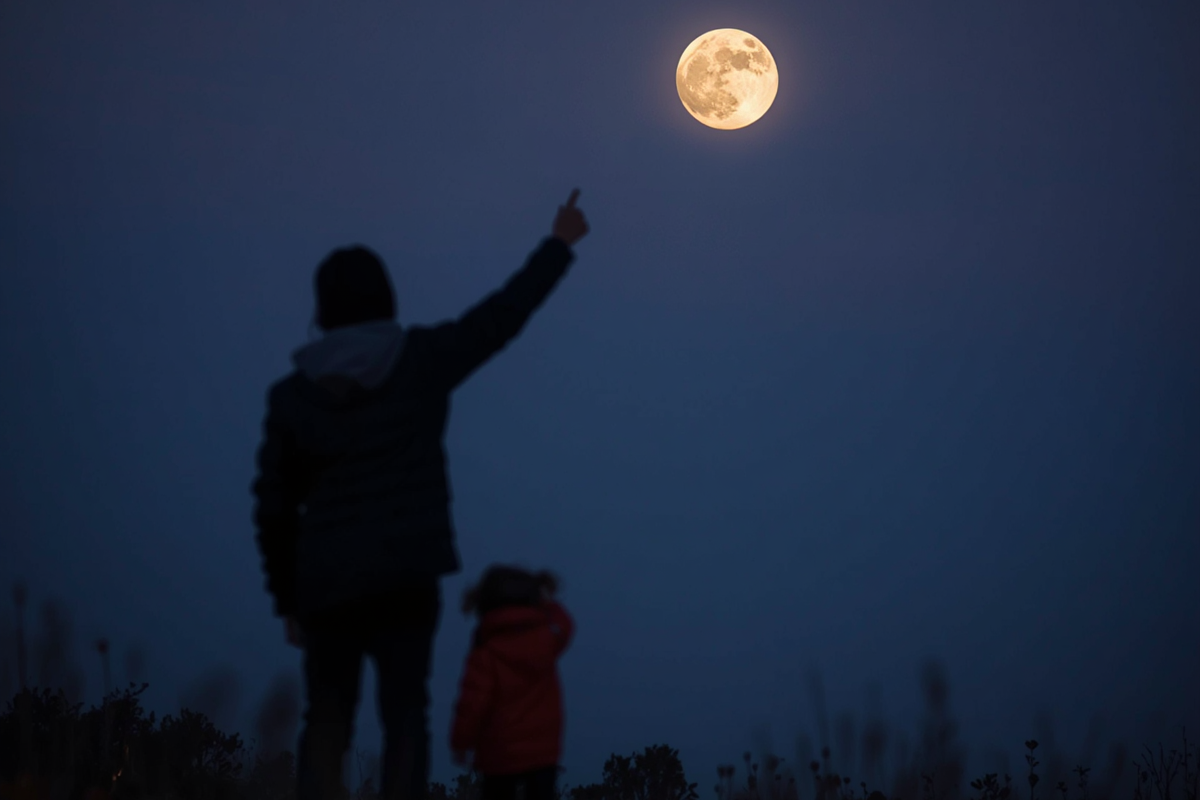
People ask me what I am teaching my daughter. The honest answer is: the moon.
Not letters. Not numbers. Not colours, shapes, or the alphabet song. The moon.
Aanya is 20 months old. She cannot read. She cannot count past the number of fingers she decides to hold up, which varies. She can, however, spot the moon from a moving car at dusk and yell the word with full confidence. She has been doing this since she was about 13 months old.
When I tell other parents that astronomy is the first "subject" I introduced, the response is almost always the same. A pause. A polite smile. Then: "But are you doing any reading with her?"
Yes. We read books every day. But I did not sit down and decide to teach her reading. I sat down and decided to teach her to notice things. The moon happened to be the most noticeable thing in the sky.
Reading can wait. Curiosity cannot.
Here is what I believe, and I know it is not popular: a 20-month-old does not need to be on a path toward reading. She will read. The on-ramp for reading is well-understood, well-supported, and available from ages 4 to 6 in virtually every school system on the planet. There is no shortage of opportunities to learn to read.
Curiosity is different. Curiosity is not a skill you pick up at school. It is a disposition that forms in the first few years of life based on what the adults around you pay attention to. A child whose parent points at the sky learns that the sky is worth looking at. A child whose parent points at flashcards learns that flashcards are worth looking at.
I chose the sky.
Dr. Alison Gopnik at UC Berkeley has spent a career on this. In The Scientist in the Crib she argues that young children learn by forming hypotheses and testing them, much like scientists do. They are not blank slates waiting for instruction. They are already running experiments on the world. The question is whether we give them interesting material to experiment with, or whether we hand them a laminated card with the letter A on it.
What does a 20-month-old even learn from astronomy?
Three words. Moon. Sun. Earth. That is the entire vocabulary Aanya has picked up from months of astronomy exposure. She calls every planet "ball," which is technically not wrong.
If you measure by knowledge transferred, this is a terrible return on investment. Months of pointing at the sky, running a ceiling projector at bedtime, flipping through space pages in books. All for three words.
But knowledge is not the point. The point is what happened around those three words.
She learned that the same object (the moon) looks different on different nights, and that this is interesting, not frightening. She learned that things in books also exist in the real world, because the moon in her Reader's Digest book is the same moon outside the window. She learned that her father finds the sky interesting, which means the sky must be worth her attention too.
None of that shows up on a developmental checklist. All of it matters.
The thing nobody tells you about early learning
The purpose of exposing a toddler to a subject is not knowledge. It is comfort.
A child who has heard the word "planet" hundreds of times by age 3 does not know what a planet is. But when that word appears in a book at age 6, it is not foreign. It is familiar. It feels like something she already knows, even though she is only now learning the definition. That familiarity removes friction. It makes the real learning, when it comes, faster and less intimidating.
This works for any subject. Music, swimming, chess, languages. But astronomy has a unique advantage for toddlers: the material is free and literally above your head every night. You do not need a chess set, a pool, a piano, or a tutor. You need a clear evening and the willingness to stand outside for two minutes and say "moon."
I have written a full guide to astronomy at home with kids that covers ages 1 to 12. The first four years require no equipment at all.
I am not against reading
I want to be clear about this because the headline is deliberately provocative. I am not against teaching reading. I am against the assumption that reading is the only serious early-learning activity, and that anything else is a hobby or a distraction.
Aanya will learn to read. She will learn math. She will learn both of those things on a normal timeline, supported by her school and by us at home. I am not worried about it.
What I am worried about is the window for building a disposition. The window where a child decides, based on what the adults around her pay attention to, whether the world is interesting or whether it is a series of tests to pass. That window is open right now, at 19 months. It will not be open forever.
So every evening, when the sky is clear, we step outside. She points up. I say "moon." She repeats it. And I believe, without any evidence I could publish in a journal, that this is the most important thing I am teaching her.
The moon is patient. It will be there tomorrow. And so will we.
If you want a structured way to keep up weekly astronomy activities (or chess, swimming, music, and seven other domains) without it feeling like school, Summiva builds a personalised weekly plan based on your child's age and your family's pace. I built it because I needed it. And if you just want to capture what your child is curious about right now, we made a free Dream Sheet for exactly that.
Turn this into one calm week
Summiva turns goals like this one into a few small real moments a week, matched to your child's age. Built by the parent who wrote this post. Free to start, no card.
One goal free forever. No streaks, no guilt.