 Summiva
Flashcards won't teach your toddler to read. We skip them anyway.
By Anand Yadav · @summiva.app · Posted 15 July 2026 · 5 min read
Open Instagram on any given evening and somewhere in the first ten scrolls there is a toddler slapping flashcards. Animal cards, sight-word cards, cards in three languages. The captions glow. The comments ask where to buy the set. And if you are a parent of a two-year-old who owns zero flashcards, a small voice asks whether you are the lazy one.
I have heard that voice. Here is what I have decided about it.
There is not a single flashcard in our house. Not because we forgot to buy them. It is a decision, and it is one of the few parenting decisions I have never once wobbled on. I will say clearly what I always say: I am not telling you the flashcard parents are wrong. Plenty of loving, thoughtful parents drill cards. It is just not for us, and I think the reasons are worth writing down, because nobody selling the cards will ever mention them.
What a flashcard actually teaches
When a toddler learns to shout "dog!" at a card, something real has happened, but it is not reading and it is mostly not even learning about dogs. It is fast picture-matching, a memory trick performed for an audience. Toddlers are spectacular at it, which is exactly why it makes such satisfying video content. The trouble is what it looks like. It looks like a head start.
The one time researchers properly tested that promise, it collapsed. A randomised trial at New York University gave baby-reading media kits, cards, videos, word books, to families of infants for seven months. The result was no measurable effect on reading ability at all. Not smaller. None. The most striking part of the study was that many parents remained convinced it was working. That is the flashcard business model in one sentence: the product does not have to work, it only has to look like it is working.
Meanwhile the professional guidance for this age group is almost comically unlike a drill. The National Association for the Education of Young Children puts it in five words: describe, but don't drill. Talk about the pictures. Let the child fill in the animal sounds. Wander off mid-book and come back. That is the actual evidence-backed toddler curriculum, and it costs nothing.
This exact thing has been sold before
The flashcard pitch is not new. It is one of the oldest recurring products in parenting, and it has been formally warned against for longer than most of us have been alive. In the 1960s the Glenn Doman programme had parents flashing word cards at babies to build "brain organisation". The American Academy of Pediatrics formally cautioned against the method in 1968 and felt the need to reaffirm that warning in 1999, 2002, and 2005, noting the theory was outdated and the evidence absent. Four separate warnings across four decades, and the cards kept selling.
Then came "Your Baby Can Read", which put the same promise on television and sold roughly 185 million dollars of kits to parents of infants. It ended with the Federal Trade Commission charging the company over its claims and a judgment equal to the company's entire gross sales. The science never supported it. The marketing never needed the science.
Today's version is prettier. Pastel cards, Montessori fonts, captions that say "science-backed". I went looking at the pages that rank when a worried parent searches whether flashcards work, and they share one habit: the word "science" appears in the titles, and no actual study appears anywhere on the page. The pitch has survived sixty years by changing its typeface, not its evidence.
The real cost is not the money
Here is the honest part: a pack of flashcards will not damage your child. If your toddler genuinely treats the cards as a game, chews them, builds towers with them, fine. The cost is subtler, and it lands on the parent. The cards install a scoreboard in your head. They convert ten minutes that would have been a lap and a book into ten minutes of quiz. And they teach you, gently, repeatedly, to want the wrong thing: performance now instead of appetite later.
My daughter is nearly two. She has an alphabet toy where the letters lift out, and she uses it to name the pictures hiding underneath, owl, kite, lion, while ignoring the letters completely. She drags the same three fairy-tale books to me and retells them from the pictures, wrong words, right rhythm. Every bit of the reading science I have read says this, not a drilled card, is what on-track looks like at her age. I have written up what we do instead, the foundation, the honest phonics timeline, the whole map from birth to ten, and none of it involves a card.
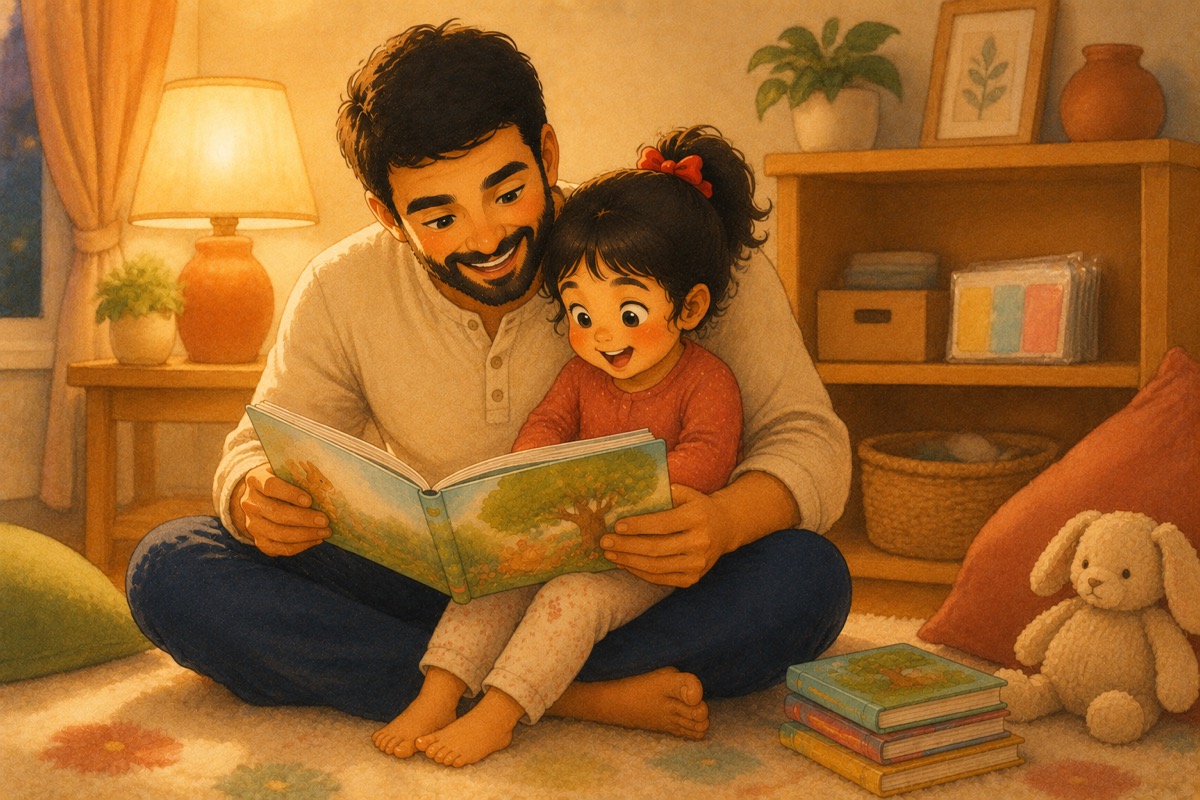
So when the small voice asks whether skipping flashcards makes me the lazy parent, I have my answer ready. The lazy option is the one that outsources the evening to a drill and calls it education. The harder, better thing is the fortieth reading of the same book with full commitment to the silly voices. She will read on her own clock. Until then I refuse to trade her appetite for a party trick.
Sixty years of warnings say the cards will be back next season with a new font. Let them come. Our shelf is full of books, and the seat next to me is taken. If you want a gentler rhythm for building towards reading, a few small real moments a week, that is what Summiva is for. One calm week at a time.
Turn this into one calm week
Summiva turns goals like this one into a few small real moments a week, matched to your child's age. Built by the parent who wrote this post. Free to start, no card.
One goal free forever. No streaks, no guilt.