 Summiva
When to start phonics for toddlers (and when not to)
By Anand Yadav · @summiva.app · Posted 8 July 2026 · 9 min read
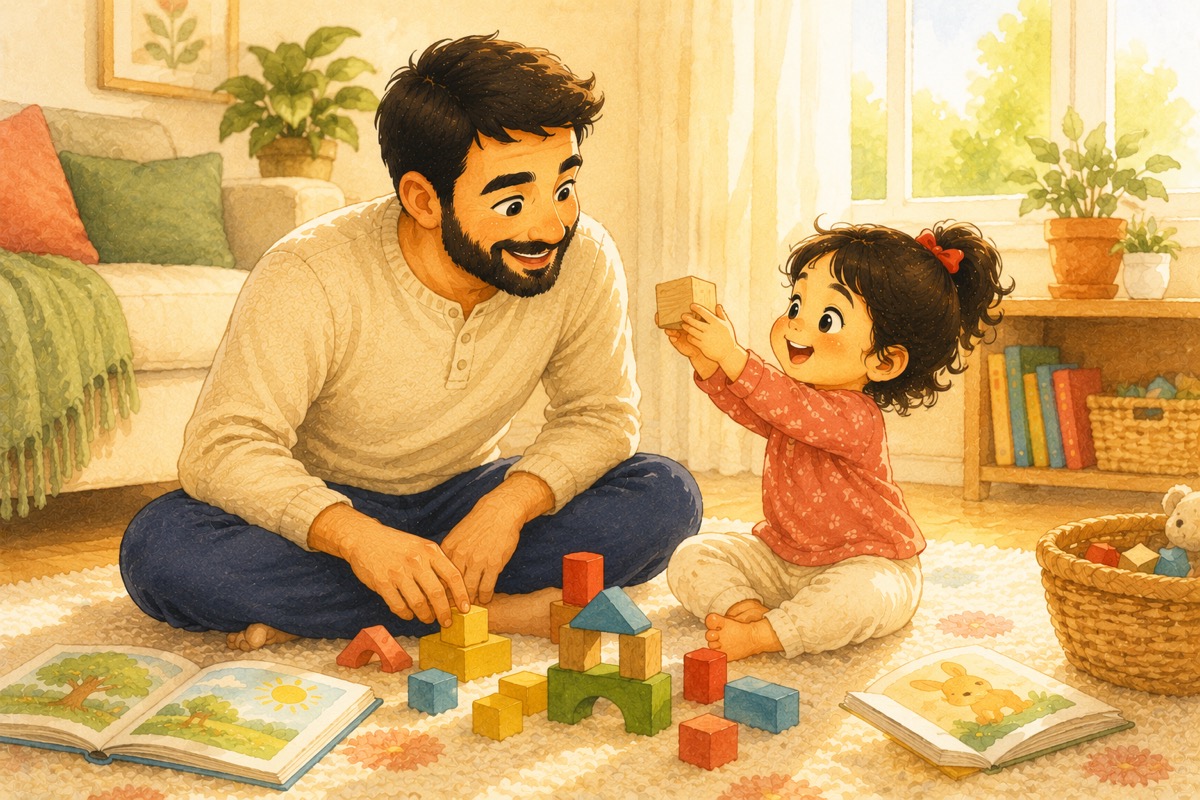
Somewhere between the alphabet posters, the singing letter apps, and the friend whose two-year-old is "already doing phonics", it starts to feel like you are late. Like there is a starting gun you missed. So here is the honest answer, the one the people selling phonics programmes will not lead with: for almost every toddler, it is too early to start phonics, and that is not a problem to fix. It is exactly where a toddler is supposed to be. What the toddler years are really for is the ear for sounds and the love of books that phonics later plugs into. That part you can do today, and it looks nothing like a lesson.
The pressure comes from everywhere at once. Adverts for singing letter apps. A cousin who mentions, lightly, that her toddler already knows all her sounds. Reels of two-year-olds flipping through flashcards while a caption promises early reading. None of it is meant unkindly, and almost none of it is what it looks like. But it adds up to a quiet worry that you are behind before your child can reliably use a spoon. You are not. Let us walk through what phonics actually is, when it genuinely belongs, and what to do in the years before then.
What phonics actually is, and what it is not
Phonics is teaching the link between the sounds of speech and the letters that stand for them, so a child can decode, or sound out, words they have never seen before. That is the whole job of phonics: c-a-t becomes "cat", and once the system clicks, the child can also read "cot", "cap" and a thousand words nobody showed them. It is powerful, and it is a school-age skill.
The reason "when should I start phonics" gets so tangled is that three different things get lumped under the same word. They are not the same, and only one of them is a toddler job.
- Phonological awareness is hearing and playing with sounds, with no letters at all. Rhyme, rhythm, clapping the beats in a name, noticing that "cat" and "hat" end the same way. This is an ear skill, and it is the real work of the early years.
- Letter recognition is knowing that a shape is called "S" or makes a "sss". Useful eventually, but recognising a letter is not the same as reading with it.
- Phonics is the bridge between the two: connecting those sounds to those letters to decode written words. This is what schools teach, and it comes last.
Here is that distinction in my own living room. Aanya has a wooden alphabet toy where each letter lifts out and there is a little picture underneath. She loves it. She pulls out the letters and names the pictures: owl, kite, lion. What she is not doing, and has no interest in doing, is saying "O", or "the sound O makes". She is naming pictures she recognises, which is vocabulary and delight, and it is genuinely good for her. It is just not phonics, and it does not need to be. If I turned that happy game into a drill about letter sounds, I would most likely trade the delight for nothing.
Is it too early to teach my toddler phonics?
For real phonics, the sit-down, sound-by-sound kind, yes, it is almost always too early before about four. A toddler under three is not yet wired to hold a letter, map it to an abstract sound, blend several of those together, and hear a word come out. That is a lot of machinery, and it comes online later, on its own timetable, in nearly every child.
You can absolutely train a two-year-old to bark the sound for a flashcard. Children are wonderful mimics. But mimicry is not decoding, and the evidence that pushing it early buys any lasting advantage simply is not there. What a toddler is superbly ready for is the layer underneath phonics: the sounds of language, the words, the stories. Build that, and phonics has something to plug into when it arrives.
When do children actually start phonics?
Most children begin formal phonics around age four to five. In England, synthetic phonics is taught from Reception, the year children turn five, and it is checked in the Year 1 phonics screening check at age five or six. In the United States, systematic phonics typically starts in kindergarten. The influential National Reading Panel review found that systematic phonics helps most from kindergarten and the first year of school onward, which is to say, from around age five, not two.
The clicking into place of actual reading usually happens between ages five and seven, with a wide range that is completely normal. The economist Emily Oster, who reads the parenting evidence carefully, makes the useful point that the year to watch most closely is first grade, around age six, when decoding should start to take. A two-year-old is not behind on phonics. A two-year-old is years away from the starting line, by design.
What to do at one to three instead: build the ear, not the letters
The clearest map of where all this is heading is Hollis Scarborough's Reading Rope. It shows skilled reading as two strands twisted together. One strand is word recognition, which includes phonological awareness, decoding, and recognising familiar words. The other is language comprehension: vocabulary, background knowledge, and how sentences and stories work. Phonics lives in the first strand. Almost everything you can do with a toddler feeds the second strand, plus the phonological awareness that sits at the root of the first.
In plain terms, the toddler job is the ear and the love of books, not the letters. That is nursery rhymes and songs, which are sneaky phonics because rhyme and rhythm train the ear to hear that words are built from smaller sounds. It is clapping the beats in a name. It is silly sound games, lots and lots of talk, and the same board books read for the fortieth time. If you want the full menu of this, I laid it out as five simple roots in how to teach a toddler to read, and as practical daily moments in pre-reading activities for toddlers.
You will know it is working because it will not feel like work. It is the toddler who fills in the last word of a rhyme you pause on, who giggles when you swap the start of a familiar word to make it silly, who bangs out the beats of a song on the table. It is answering "what is that noise?" for the hundredth time in a day. None of it needs a plan or a purchase. It just needs you, out loud, more often than feels productive.
What about the "your baby can read" promise, and phonics apps?
This is worth slowing down on, because the marketing is loud and it is convincing. The most famous product in this space, "Your Baby Can Read", sold millions of units before the company folded in 2012 following a US Federal Trade Commission complaint over its claims. In 2014, a team led by Susan Neuman ran a proper randomised trial of a baby-reading media product with infants aged nine to eighteen months. Over seven months, the babies who used it did not learn to read. There was no measurable effect on reading ability, even though many parents were sure it was working. What those parents were watching was their child memorising whole word-shapes, which looks like reading and is not.
The branded phonics programmes people ask about, Jolly Phonics, Hooked on Phonics and the rest, are a different thing again. They are structured schemes built for children who are ready for formal phonics, which means roughly age four and up, not toddlers. You do not need to buy any of them for a one, two, or three-year-old. And the app versions run into the same wall the American Academy of Pediatrics keeps pointing at: a screen cannot give a young child the back-and-forth that a real person does, and for the youngest children the guidance is to keep screens to a minimum.
I will be honest about our own choice here. I have never once used a phonics app or a reading app with Aanya, and I do not plan to before she is well into school, if at all. It is not a judgement of parents who do. It is just that everything the research points to, and everything I have watched in her, says the lap and the book beat the screen at this age, every time. We kept the apps out and the books out instead. For which books are actually worth having on the shelf, and which "learn to read" products to skip, I went through it in best books for toddlers learning to read.
Signs your toddler is warming up to sounds (not a checklist to race)
Some toddlers do start reaching towards this on their own, and it is lovely to follow when they do. You might notice they join in on the rhyming word before it comes, they spot that two words sound alike, they play with making sounds, or they point at the first letter of their name and ask what it is. These are signs the ear is switching on. They are observations to enjoy, not boxes to tick or evidence you should push harder.
If your child does ask about a letter, give them the sound it makes more than its name, because "mmm" helps with reading in a way that "em" does not. Keep it inside the flow of play and books, never a sit-down lesson, and watch their face. The moment curiosity tips into restlessness, stop, cheerfully, with no sign of disappointment. You want them to leave every brush with letters wanting a little more. Following your child's lead and pushing your agenda are opposite things, even when they involve the same letter.
When starting too early actually backfires
The risk of early phonics drills is not that they turn your child into a genius one year sooner. It is that they can quietly cost you the thing that matters most. The single strongest predictor that a child will get through the genuinely hard work of learning to decode is that they already love books and believe reading is for them. Pressure, testing, and comparison at two erode exactly that. A child who was drilled and a child who was read to for pleasure often end up reading at the same time, but only one of them arrives loving it.
There is a responsible flip side worth saying plainly. If, by around the first year of school, roughly age six, decoding genuinely is not starting to click, that is the point to ask questions and seek support, sooner rather than later. The same goes if you have any worry about your child's hearing or speech. In a multilingual home like ours, judge the milestones across all the languages together, not one at a time. Before then, for a toddler, the most valuable thing you can do is keep the foundation growing and keep books a pleasure.
If you want to see where phonics sits in the whole journey, birth to ten, the full map is in reading milestones by age.
That gentle, one-small-thing-a-day rhythm is the whole idea behind Summiva. It hands you a simple weekly plan of tiny, real moments towards a goal you have chosen, reading and language included, so you never sit there at the end of a long day wondering whether you should be running flashcards. You should not. You should read the board book again, sing the silly song, and let phonics arrive on its own clock. One calm week at a time.
Frequently asked questions
What is the difference between phonics and phonological awareness?
Phonological awareness is hearing and playing with the sounds in speech, rhyme, syllables, and the first sound in a word, with no letters involved. It is an ear skill. Phonics is linking those sounds to written letters so a child can decode words on a page. Phonological awareness comes first and is the natural toddler job. Phonics builds on top of it later, usually from around age four or five.
Can a 2 year old learn phonics?
A two-year-old can memorise letter sounds as a party trick, but that is not the same as decoding, and there is no evidence it gives a lasting head start. Most two-year-olds are not developmentally ready for real phonics. What genuinely helps at two is talking, sharing books, and playing with rhymes and sounds, which build the ear that phonics later plugs into.
When should my child start phonics?
Formal phonics usually starts around age four to five. In England, synthetic phonics is taught from Reception and checked in the Year 1 phonics screening check at age five or six. Decoding typically clicks between five and seven, with a wide normal range. Before four, the priority is oral language and love of books, not sounding out words.
Is Jolly Phonics or Hooked on Phonics good for toddlers?
These are structured programmes designed for children who are ready for formal phonics, usually from around age four upwards, not toddlers. You do not need to buy a programme for a one, two, or three-year-old. Nursery rhymes, songs, chatter, and shared books do more for a toddler than any phonics scheme, and they are free.
My toddler can sing the alphabet, is that phonics?
No, and that is fine. Singing the alphabet song is a lovely memory feat and shows your child enjoys language, but it is reciting a tune, not decoding. Knowing the names of letters is also different from knowing the sounds they make, and neither is the priority at this age. Enjoy the song and keep reading together.
Turn this into one calm week
Summiva turns goals like this one into a few small real moments a week, matched to your child's age. Built by the parent who wrote this post. Free to start, no card.
One goal free forever. No streaks, no guilt.