 Summiva
Reading milestones by age: a parent's guide
By Anand Yadav · @summiva.app · Posted 13 July 2026 · 9 min read
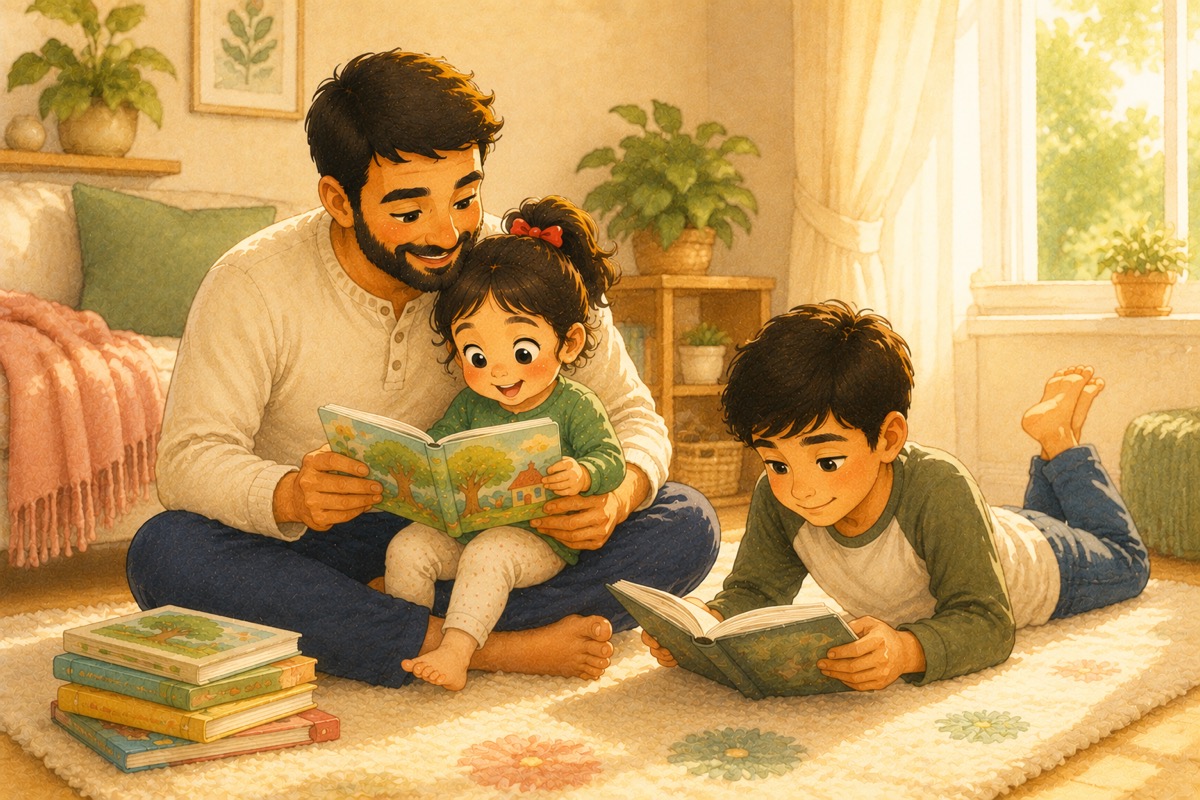
Search for reading milestones and most of what you find is written by companies selling a reading app, which gives them a quiet interest in making you feel your child is behind. So here is the version with nothing to sell you: the honest map of how reading develops from birth to about ten, what is genuinely normal at each stage, the few signs actually worth acting on, and how to raise a reader without turning your home into a classroom. My daughter is not quite two, so our house is living the first stretch of this map right now, and the later stretches are drawn from the reading science, cited as we go.
When do kids learn to read?
Most children learn to decode, that is, to sound out words they have never seen, between ages five and seven, usually within their first two years of formal schooling. Some click at four. Some click at eight. Research following early and late readers finds the two groups largely indistinguishable by around age twelve. The range is wide because reading is not one skill but two big strands woven together, word recognition and language comprehension, and the second strand starts building from birth, years before the first.
That framing comes from Hollis Scarborough's Reading Rope, the clearest model in the reading science. It is also why "milestones" below start at birth, long before letters: the talking and listening years are not a waiting room. They are half the rope.
Birth to 3: the talking years
Nothing in this stage looks like reading, and all of it is reading. The milestones worth noticing: your baby turns towards your voice and babbles back at you. Around one, first words arrive. Through two, vocabulary snowballs and two-word sentences appear. With books, a toddler on track will enjoy being read to, hold the book and turn pages, point at pictures and name them, demand the same book for the fortieth time, and eventually "read" a favourite book back to you from memory.
That last one still catches me. My daughter Aanya, at twenty-three months, will pull a book off the shelf, climb up beside me, and retell it in her own scattered words, half a line here, a character there, the rhythm more than the text. It looks uncannily like reading. It is not, and that is fine, because it is the exact milestone for her age: she knows books hold stories, stories have order, and print means something. If you want the deep version of this stage, I have written it up as the honest guide to teaching a toddler to read, a week of pre-reading activities, and the books actually worth owning.
What is NOT a milestone at this age: knowing letters, reciting the alphabet, or anything a flashcard promises. Aanya has an alphabet toy where each letter lifts out to show a picture underneath, and what she does with it is name the pictures, owl, kite, lion, and ignore the letters entirely. That is a two-year-old doing exactly what a two-year-old should.
Ages 3 to 5: sounds and letters start to mean something
This is the phonological awareness stage, the ear training that decoding later stands on. Milestones look like: joining in on rhymes and finishing the rhyming word before you do, noticing that words can sound alike, clapping out the beats in a name, recognising their own name in print, and asking what signs and packets say. Somewhere in here most children start recognising some letters, usually the ones in their own name first, and pretend-writing appears as scribbles that clearly mean something to the author.
Formal phonics belongs at the very end of this window or after it, around four to five at the earliest, and even then only if the child is game. I have gone deep on that timing question, including what the programmes selling early phonics will not tell you, in when to start phonics. The short version: build the ear first, and let school do the drilling.
Ages 5 to 7: the decoding years
This is where reading in the everyday sense actually happens, and school carries most of it. Milestones: learning letter-sound links systematically, blending sounds into words, reading simple decodable sentences, recognising a growing set of common words on sight, and somewhere in this window, the click, the day text stops being a puzzle and starts being language. Reading aloud is slow and effortful at the start of this stage and noticeably smoother by the end of it.
Two things matter most from the parent side here. First, keep home reading a pleasure while school makes it work: your job is the bedtime story, not the worksheet. Second, this is the one window where the timeline genuinely deserves your attention. The economist Emily Oster's read of the evidence is that around first grade, roughly age six, is when to watch whether decoding is starting to take. Not panic, watch.
Ages 7 to 10: reading to learn
The milestone language flips: instead of learning to read, your child starts reading to learn. Fluency arrives, reading aloud starts to sound like talking, silent reading takes over, and comprehension becomes the whole game: following chapter books across days, understanding characters' motives, arguing with the ending. A nine-year-old on track can read something and tell you what it meant, not just what it said.
The quiet risk in this stage is not ability but appetite. This is where children decide whether reading is a thing they do or a thing school makes them do. The strongest lever you have is embarrassingly simple: let them read what they love, comics and joke books and the same series eleven times included, and let them see you reading. Taste can be developed later. The habit cannot be retrofitted.
When to worry, and when to wait
The honest rule: before age six, almost everything on the worry list is normal variation. After that, a few specific signs deserve a real response rather than reassurance. Talk to the school, and consider a hearing and vision check, if by around six to seven, letter-sound links simply are not sticking despite steady teaching, or your child cannot hear rhyme at all, or reading is producing genuine distress rather than ordinary effort. Earlier than that, raise speech and language concerns with a professional whenever your gut says so: a two-year-old with very few words is a speech question, not a reading one.
One note from our own home: we speak three languages around Aanya, English, Marathi, and Kannada. If your house is multilingual, judge milestones across ALL the languages together. A child who knows some words in each language is often exactly on track in total, and mixing languages in one sentence is a feature of multilingual childhood, not a delay.
The one rule that beats every milestone
Every stage above has one thread running through it: the children who end up reading well are overwhelmingly the ones who end up loving it, and love is built in the low-pressure moments, the lap, the fortieth reread, the silly voices, the comic books you resisted buying. The milestone chart is for your peace of mind, not for your child's schedule. Use it the way you use a growth chart: glance occasionally, act on real outliers, and otherwise let the child grow.
If a checklist ever makes you feel behind, close the checklist. Read the book instead. That is never the wrong milestone.
That is also the entire philosophy behind Summiva: it hands you a few small, real moments each week, matched to your child's age and stage, reading among them, so the foundation builds itself one calm week at a time, with no drills and no guilt.
Frequently asked questions
When do kids learn to read?
Most children learn to decode words between ages five and seven, usually in their first year or two of formal schooling. Some click at four, some at eight, and by around age twelve early and late starters have largely evened out. The years before that build the foundation: talking, listening, and loving books.
Is my child behind if they are not reading at five?
Almost certainly not. Five is the early edge of the normal decoding window, not the deadline. The year to watch is around age six to seven, when phonics instruction should start to click. If it genuinely is not clicking by then, ask the school and consider a hearing check. Before that, wide variation is normal.
What are the reading milestones for a toddler?
Toddler milestones are not about letters. They are: enjoying being read to, holding books and turning pages, pointing at pictures and naming them, filling in words of favourite rhymes, and pretend-reading a familiar book from memory. A toddler doing those things is exactly on track, no letter drills required.
Do reading milestones differ for bilingual or multilingual children?
The stages are the same, but judge milestones across all of a child's languages together, not one at a time. A multilingual child may know fewer words per language early on while their total vocabulary is right on track. Mixing languages in one sentence is normal and sorts itself out. More on this in will a second language confuse my toddler?
Should I teach my child to read before school starts?
You do not need to, and pushing formal reading early has no proven lasting advantage. What genuinely helps is the foundation: talk constantly, read together daily, sing rhymes, and let letters come up in play. A child who arrives at school loving books learns to read more happily than one who arrives drilled.
Turn this into one calm week
Summiva turns goals like this one into a few small real moments a week, matched to your child's age. Built by the parent who wrote this post. Free to start, no card.
One goal free forever. No streaks, no guilt.