 Summiva
Best books for toddlers learning to read
By Anand Yadav · @summiva.app · Posted 5 July 2026 · 10 min read
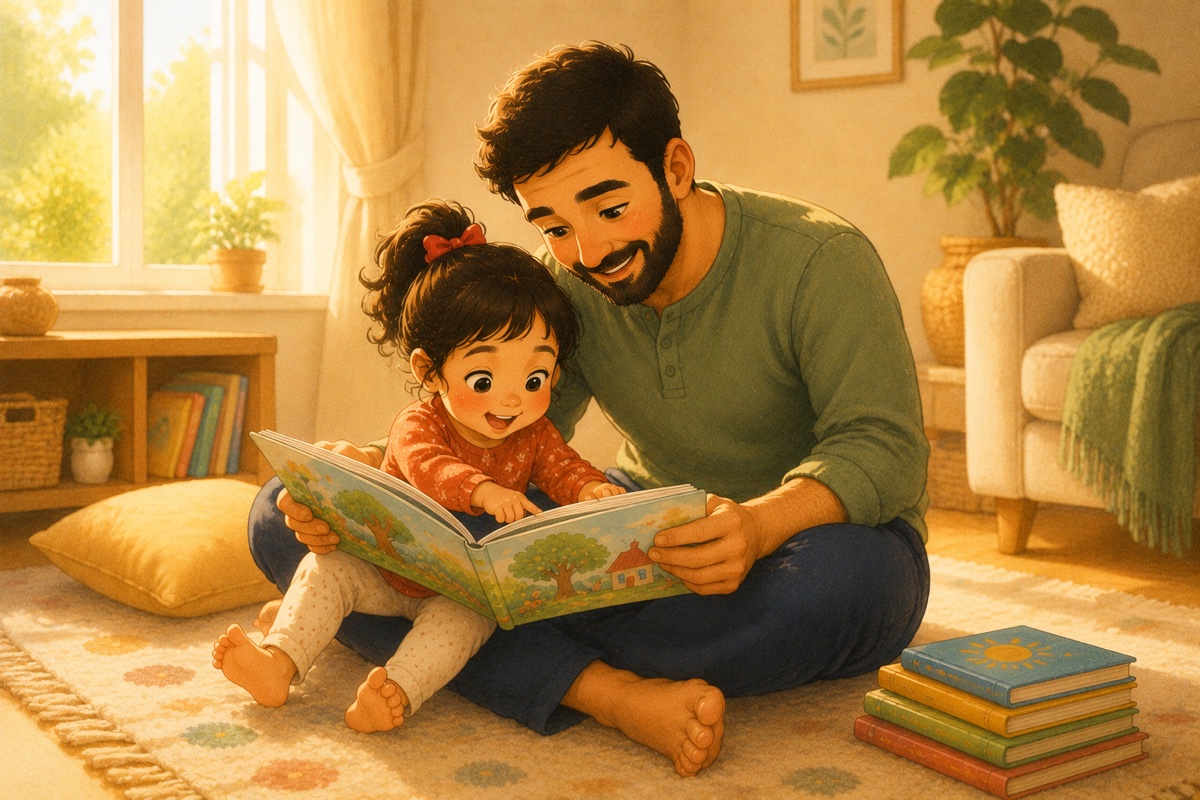
Type "best books for toddlers learning to read" into a search bar and almost every list quietly mixes two things that should never share a shelf. Soft board books for a one-year-old sit right next to Bob Books, which are formal phonics readers whose own makers tell you to wait until four or five. So parents buy the wrong thing, hand it to a toddler who is nowhere near ready, and hit a wall of frustration that was never the child's fault. This is the honest version, written for a real one to three-year-old and sorted by what each kind of book actually builds. My daughter Aanya is about twenty-two months old, and her actual shelf has three fairy tales on repeat, Cinderella, the Three Little Pigs and the Wolf, and the Pied Piper, nothing that looks anything like a phonics workbook.
The short answer, and a shelf by age
The best books for a toddler learning to read are not phonics readers. They are rich board books, rhyming books, and alphabet books that build the pre-reading foundation: handling a book, an ear for sound, and a love of stories. Formal decodable readers come later, usually at four or five, once a child already knows some letter sounds.
As a shopping order, here is what to reach for first, by age.
- First-words and board books, roughly 1 to 2. Durable, chewable, page-grabbable books that build print handling, shared attention, and vocabulary.
- Rhyming books, roughly 2 to 3. Rhyme and rhythm that build phonological awareness, the ear for the small sounds inside words.
- Alphabet books, roughly 2 to 3. Gentle, playful letter exposure. Not drilling, and not a flashcard in disguise.
- First phonics and decodable readers, usually 4 to 5. Only once a child knows basic letter sounds. Too early and they backfire.
Reading TO a toddler is not teaching one to read
Reading to a toddler and teaching a toddler to read are two different jobs, and the confused search results come from treating them as one. Reading to your child builds the foundation and the love of books. Teaching a child to read means decoding, turning letters into sounds into words, and most one to three-year-olds are not wired for it yet. An eighteen-month-old will not decode, and that is fine.
The economist Emily Oster, who reads the parenting evidence carefully, points out that the year to watch is first grade, around age six, when decoding should start to click. Before that the useful work is all foundation, which is why the honest way to choose toddler books is to ask what each one builds.
In the first post I laid out the five roots of reading: talk, read, sing, play, and notice print. The four book types here map almost one to one onto them. Board and first-words books feed talk and print handling, rhyming books feed the sound-aware root, alphabet books feed noticing print, and phonics readers are the school-age job all of it grows towards. The case against pushing letters early is in the honest guide to teaching a toddler to read, and Zero to Three on the twelve to twenty-four month stage agrees: at this age it is conversation and shared books, not drills.
Board books and first-words books (the real 1 to 2 shelf)
At one to two, the board book wins on durability alone. It survives being chewed, dropped, and grabbed by the fistful, and while it takes that beating it teaches the quiet basics: how a book is held, which way the pages turn, how you and your child look at the same thing at the same time. This is the shelf the affiliate roundups underserve. It is also the one that matters most right now. A few that earn their place, and why:
- Dear Zoo by Rod Campbell. Lift-the-flap cause and effect, so little hands do something on every page and learn that a book responds to them.
- Brown Bear, Brown Bear, What Do You See? by Bill Martin Jr and Eric Carle. Heavy repetition plus colour and animal words, which is exactly how toddlers bank new vocabulary.
- Moo, Baa, La La La! by Sandra Boynton. Pure sound play and silliness, short enough to survive a wriggly lap, and genuinely funny to read aloud.
- First 100 Words by Roger Priddy, or Eric Carle's My Very First Book of Words. Naming books that turn point-and-say into a game and grow the vocabulary that comprehension later runs on.
On our own shelf the three books Aanya reaches for most are her fairy tales, Cinderella, the Three Little Pigs and the Wolf, and the Pied Piper. She flips through the pages herself now, points at a picture, tries to name it, then points at the next one and asks me what is this, page after page. None of the naming books above are what she is doing it with. It is proof that the behaviour matters more than the specific title: any book with enough to point at will get used this way.
One honest note: you do not need to own most of these. Board books are the easiest to borrow, so buy the two or three that become genuine favourites and let the library carry the rest.
Rhyming books (this is the phonological-awareness one)
Rhyming books do one quiet job better than anything else. They build phonological awareness, the ear for the smaller sounds hiding inside words, and that ear is the seed decoding grows from years later. Think about the order of it. Before a child can tie the letter "c" to a sound, they first have to hear that "cat" and "hat" end the same way. Rhyme trains exactly that, and not one letter is needed.
This is the book version of the clap-the-sounds game in the pre-reading activities post: a good rhyming book breaks words into sounds for you, over and over, disguised as fun.
- Hop on Pop and Green Eggs and Ham by Dr. Seuss. Relentless, playful rhyme built for reading aloud, which is precisely the point.
- Llama Llama Red Pajama by Anna Dewdney. Strong rhythm and a bedtime feeling toddlers ask for on repeat.
- Sheep in a Jeep by Nancy Shaw. Short, bouncy, and packed with rhyming pairs a toddler starts to anticipate.
- The Gruffalo and Room on the Broom by Julia Donaldson, for readers in the UK and beyond. Rhyme carried by a real story, which keeps them working well past age three.
We never bought Aanya a rhyming book. What she has instead are two rhymes we taught her by voice, Johnny Johnny Yes Papa and Twinkle Twinkle Little Star, and she still breaks into one of them completely unprompted, weeks after we last sang it with her. That unprompted recall is the whole mechanism in miniature. The rhyme stuck in her ear long before she could read a word of it, which is exactly what a good rhyming book is trying to do on paper.
Alphabet books (exposure, not drilling)
The point here is exposure, not instruction. An alphabet book is for meeting letters and enjoying them, not for drilling the ABCs, and at this age the sound a letter makes matters more than its name anyway. Read one at bedtime and it is lovely. Turn it into a quiz, page after page, and you have made a flashcard with a spine.
Is Chicka Chicka Boom Boom good for teaching letters? Yes, for exposure and rhythm, no, for decoding, and that is the right expectation. It gets the whole alphabet into a chant a toddler wants to hear again, which is all you want a letter book to do before four or five.
- Chicka Chicka Boom Boom by Bill Martin Jr and John Archambault. The alphabet as a rhythmic story, not a drill.
- LMNO Peas by Keith Baker. Playful little pea characters that make each letter something to look at rather than recite.
- Eating the Alphabet by Lois Ehlert. Real fruits and vegetables A to Z, tying letters to things a toddler already knows.
- Alphablocks books, for UK families who already know the characters. Letters shown as sounds, which is the useful emphasis.
Aanya does not have an alphabet book yet. What she does have is an alphabet toy, a board where each letter lifts out and there is a small picture underneath it, an owl under the O, a kite under the K, a lion under the L. She pulls a letter off, and instead of naming the letter she names whatever is hiding under it. That is exposure exactly as it should look at this age, letters turning up next to things she already knows, with nobody testing her on either.
The honest line to hold onto: an alphabet book is not a flashcard, and you do not need flashcards. Letting the alphabet turn up in a book they love is the version that keeps a child curious.
First phonics and decodable readers (for later, usually 4 to 5)
These are the books the search results wrongly push at toddlers, and being straight about them is why this list exists. First phonics and decodable readers are for later, usually four or five, once a child already knows basic letter sounds. Handed to a two-year-old they do not teach reading, they teach that books are hard, which is the one outcome you are trying to avoid.
So, are Bob Books good for a two-year-old, and what age should you start Bob Books? They are a well-made decodable series, but the publisher's own guidance starts them at around age four, after a child knows some letter sounds, and warns against starting too early. Believe them. That readiness check is more important than the box's brand.
It helps to know the two kinds of beginner reader. Decodable books use only letter sounds a child has already been taught, so they can sound the words out. Sight-word or levelled readers lean on memorising whole words with heavy picture support, which can slide into guessing. Reading Rockets explains why decodable books matter for beginners, and current reading science leans towards them for the first steps of decoding.
For the day your child is ready, here are the series to remember rather than buy now: Bob Books, Usborne Very First Reading and Phonics Readers, Jolly Phonics readers, and in the UK the Oxford Reading Tree with Biff, Chip and Kipper. The National Literacy Trust keeps a useful list of great books for teaching phonics. How do you tell it is time? When your child knows several letter sounds, can blend simple sounds out loud, and is asking what words say. Until then, this shelf waits.
For the fuller answer on why that wait is not a delay but the point, see when to start phonics for toddlers.
What to skip before four or five
A few products sold for toddlers who are "learning to read" are worth skipping on purpose. They promise a shortcut, and the evidence for it is not there. Skip the flashcard drills, the "teach your baby to read" kits, and the gimmicky reading tablets pitched at babies.
The reason is the record. The most famous baby-reading product, "Your Baby Can Read", sold millions before the company shut down in 2012 after a US Federal Trade Commission complaint over its claims. A 2014 randomised trial led by Susan Neuman at New York University found no effect on reading ability, even though parents were sure it was working. The babies were memorising word shapes, which looks like reading and is not. I went through this in depth in the honest guide to teaching a toddler to read.
Are learn-to-read apps worth it for a toddler?
At one to three, books plus a lap beat any screen, so learn-to-read apps are not worth it as instruction. There is no proven benefit of screen media for reading under two. At best an app is a co-used supplement you sit through together for a few minutes, never the thing that teaches your toddler to read, and never a replacement for a real person reading aloud.
The guidance is consistent. The American Academy of Pediatrics advises avoiding solo screen time before around eighteen to twenty-four months, apart from video calls, and Children and Screens, in its guide for ages 0 to 5, finds print beats digital for under-threes and that media should supplement real interaction, never replace it.
It also helps to know the named apps are not really pitched at toddlers. Duolingo ABC is aimed at roughly three to eight, and Common Sense Media's review of Duolingo ABC treats it as an early-school tool, not a toddler one. Teach Your Monster to Read is pre-kindergarten and up, sensibly four-plus. Hooked on Phonics carries its own readiness caveat. Even the apps agree your one to three-year-old is too young.
I should be plain about where Summiva sits, because it would be easy to read this as a sales pitch. Summiva is not an app you point at a toddler. It is a plan for the grown-up, a nudge to read the bedtime book, not a screen that reads it for you. I have deliberately not put a single reading app in front of Aanya. Not because I think they are dangerous, just because the fifteen minutes I would spend picking one is fifteen minutes I would rather spend reading her the Pied Piper again.
Borrow before you buy: a short shelf, not a library
Here is the counterintuitive part. A toddler does not need a big collection. They need a small pile of loved books read over and over, so aim for a short shelf, not a library. Re-reading the same favourite until you could recite it in your sleep is not a rut. It is how a toddler takes ownership of a story. A dozen books read to death will teach more than a hundred read once.
So borrow first. Use the library hard, see which titles your child keeps dragging back to you, and buy only those. The books you own then are the ones that already earned their place.
For the bigger picture of where these books fit, the whole road from board books to chapter books is mapped in reading milestones by age.
That calm, one-small-thing-a-day rhythm is the whole idea behind Summiva. It hands you a simple weekly plan of tiny, real moments towards a goal you have chosen, reading included, so a busy week does not quietly become a week where the books stayed shut. Pick a few good books, keep them where small hands can reach, and let the reading arrive on its own clock.
Frequently asked questions
What age should a toddler start learning to read?
There is no rush. Most children learn to decode words between five and seven, and there is no proven advantage to forcing it earlier. The toddler years are for pre-reading: talking, shared books, rhymes, and noticing print. Start those from birth and let formal reading arrive on its own clock around school age.
Are Bob Books good for a 2 year old?
Bob Books are excellent decodable readers, but not for a two-year-old. The publisher's own guidance puts them at around four and up, once a child knows basic letter sounds. Started too early they frustrate and can sour a child on reading. Keep them for later and read rich picture books now.
Do learn-to-read apps work for toddlers, and are they worth it?
Not really. There is no proven benefit of screen media for reading under two, and live reading with a real person teaches far more. Most named apps are pitched at three and up anyway. At best an app is a co-used supplement for a few minutes, never instruction, and never a substitute for your lap and a book.
What is the difference between decodable books and sight-word readers?
Decodable books use only letter sounds a child has already learned, so they can genuinely sound the words out. Sight-word or levelled readers lean on memorising whole words from repetition and pictures. Most reading-science guidance favours decodable books for beginners, because they build the decoding skill rather than the guessing habit.
How many books does a toddler actually need?
Fewer than the internet suggests. A toddler needs a handful of loved books read many times, not a big collection read once. Re-reading the same favourite is how they take ownership of a story, so it is a feature, not a problem. Borrow widely from the library and buy only the ones they keep asking for.
Should I use flashcards or a 'teach your baby to read' kit?
No. Flashcards teach word-shape memorising, not reading, and "teach your baby to read" kits have no good evidence behind them. One famous product was settled with the US Federal Trade Commission over its claims. Spend the time on talk, books, and rhymes instead. See our pre-reading activities for toddlers for what to do instead.
Turn this into one calm week
Summiva turns goals like this one into a few small real moments a week, matched to your child's age. Built by the parent who wrote this post. Free to start, no card.
One goal free forever. No streaks, no guilt.